The Economics of Legacy Test Data Management vs. GenRocket’s Quality Evolution Platform
Enterprise organizations today face a growing crisis in test data management. What began as a practical strategy for copying, masking, and provisioning production data into lower testing environments has evolved into an increasingly expensive, operationally inefficient, and high-risk model that struggles to support modern software delivery, DevOps, AI-driven testing, and data privacy requirements.
Legacy Test Data Management (TDM) platforms from vendors such as IBM, Informatica, Broadcom, and Perforce-Delphix were architected during a period when organizations had few practical alternatives to the use of production data for software testing. Synthetic data technologies were still immature, limited in scalability, and incapable of supporting the complexity of enterprise testing requirements.
Over time, this dependency became deeply embedded within enterprise quality engineering operations. But the industry has changed. Modern synthetic data technologies can now generate realistic and highly secure synthetic data capable of reducing—or in some cases eliminating—the need to replicate sensitive production data into lower environments for development and testing purposes.
However, many synthetic data solutions remain primarily focused on statistically replicating production data patterns and distributions rather than enabling truly engineered, purpose-built data provisioning for enterprise-scale testing requirements.
Rather than reproducing statistical approximations of production data, GenRocket enables precise control over data conditions, permutations, edge cases, business rules, workflow states, and complex relational integrity across enterprise systems—making it one of the industry’s most advanced synthetic data provisioning platforms.
Large enterprises commonly operate anywhere from dozens to more than one hundred production databases distributed across on-premises and cloud environments. Core transactional systems frequently measure in the multi-terabyte range, particularly within industries such as banking, insurance, healthcare, telecommunications, and retail where large volumes of sensitive customer and transactional data must be maintained for operational and regulatory purposes.
The Hidden Cost Structure of Legacy TDM Platforms
The licensing cost of legacy TDM systems is only one component of the overall burden. Organizations incur multiple layers of direct and indirect costs:
- Hefty annual software licensing fees
- Volume-based licensing fees tied to terabytes of data
- Infrastructure and storage expansion costs
- Professional services and consulting engagements
- Long refresh and provisioning cycles
- Delays in CI/CD and test automation pipelines
Many organizations underestimate the cumulative impact of these inefficiencies because the costs are distributed across infrastructure, operations, QA, DevOps, security, and database administration teams.
According to a Forrester Total Economic Impact study involving Broadcom Test Data Manager, the modeled enterprise incurred approximately $2.8 million in risk-adjusted costs over three years, including software licensing, professional services, infrastructure, and internal operational support. That equates to nearly $934,000 annually in total ownership cost for the modeled deployment.
The Volume-Based Pricing Problem
One of the most significant economic challenges in traditional TDM platforms is the dependency on volume-based pricing models. In many environments, masking and provisioning costs increase directly with database size. As enterprise databases expand, costs continue to rise even though the organization is fundamentally performing the same functions.
This creates a particularly painful economic dynamic for large enterprises in highly regulated industries such as healthcare, banking, insurance, telecommunications, and retail, where databases tend to be both extremely large and filled with sensitive personally identifiable information (PII).
A Typical Enterprise Environment
- 50 production databases
- Average database size: 5 TB
- Total production data footprint: 250 TB
250 TB × $12,000/TB = $3,000,000 annually
Importantly, this estimate excludes infrastructure, storage, refresh operations, professional services, staffing, and operational overhead.
As database footprints expand, the cost continues to rise as well.
GenRocket’s Alternative Economic Model
Rather than charging organizations based on database size, GenRocket’s In-Place Masking (IPM) solution uses a fixed-cost pricing model of $10,000 per database regardless of size. This creates predictable economics that do not continually escalate as enterprise databases expand.
More importantly, GenRocket’s architecture is fundamentally different from traditional masking platforms.
Legacy masking systems typically replicate production databases into lower environments and then perform masking operations against those copied datasets after the transfer process has already occurred. This creates multiple distributed copies of sensitive production data across development, QA, testing, and staging environments, increasing both operational complexity and security exposure.
This approach significantly reduces the exposure of sensitive production information while preserving referential integrity, realism, and application compatibility across testing environments. At the same time, organizations benefit from improved testing flexibility, accelerated provisioning operations, and stronger alignment with modern DevOps and CI/CD delivery pipelines.
A Real-World Customer Example
A global enterprise customer recently replaced a legacy TDM platform based on Delphix-Perforce with GenRocket’s Quality Evolution Platform (QEP) and achieved measurable economic results.
The customer:
- Transitioned more than 40 databases to GenRocket IPM
- Eliminated volume-based cost escalation
- Achieved more than $1 million in license savings
In this scenario, GenRocket delivers savings ranging from $2,000 to $50,000 per database depending on size. These savings scale linearly across environments—for example, 10 databases represent a potential savings of $20,000 to $500,000.
A cost comparison model demonstrates how traditional volume-based pricing becomes increasingly expensive as database sizes grow.
Cost Model Comparison
GenRocket’s fixed-cost model remains stable at approximately $10,000 per database whether the database is 1 TB or 5 TB. This creates a fundamentally different economic model for large-scale enterprise environments.
Strategic Implications for Enterprise Organizations
The traditional TDM paradigm was built for a world centered around static release cycles and limited automation. Modern enterprises now require something fundamentally different:
- Faster provisioning cycles
- DevOps and CI/CD integration
- Reduced operational complexity
- Lower infrastructure consumption
- Elimination of unnecessary production data replication
- Better support for AI and synthetic testing scenarios
- Predictable economic scaling
- Stronger privacy and compliance alignment
As enterprise data volumes continue to expand, organizations increasingly recognize that legacy TDM architectures introduce both economic inefficiencies and unnecessary security exposure.
GenRocket’s Quality Evolution Platform represents a replacement for legacy TDM platforms and an evolution toward a more scalable, secure, automation-oriented, and economically predictable model for enterprise test and training data provisioning.
The Strategic Advantage of the TDM Bridge
For many enterprises, the transition away from legacy TDM platforms cannot occur overnight. Existing data provisioning workflows, testing dependencies, compliance procedures, and operational processes are deeply embedded into enterprise delivery pipelines.
GenRocket’s TDM Bridge strategy was designed to address this reality.
This approach allows enterprises to preserve existing provisioning processes while gradually implementing targeted synthetic data generation where it delivers the greatest value. Rather than forcing a disruptive “rip and replace” migration strategy, organizations can modernize incrementally and strategically over time.
As the transition progresses, enterprises reduce dependency on copied production data, minimize infrastructure and operational complexity, accelerate testing cycles, and move toward a synthetic data-first operating model that virtually eliminates the security, privacy, and compliance risks associated with replicating sensitive production information into lower environments.
In this way, GenRocket’s Quality Evolution Platform is not simply a lower-cost alternative to traditional TDM platforms. It represents a long-term strategic evolution toward a more secure, scalable, automated, and future-ready synthetic data provisioning architecture.
To help organizations better understand the economic impact of modernizing their test data provisioning strategy, GenRocket has developed an interactive TDM Cost Savings Calculator that estimates potential licensing savings achievable by replacing traditional volume-based TDM platforms with GenRocket’s Quality Evolution Platform.
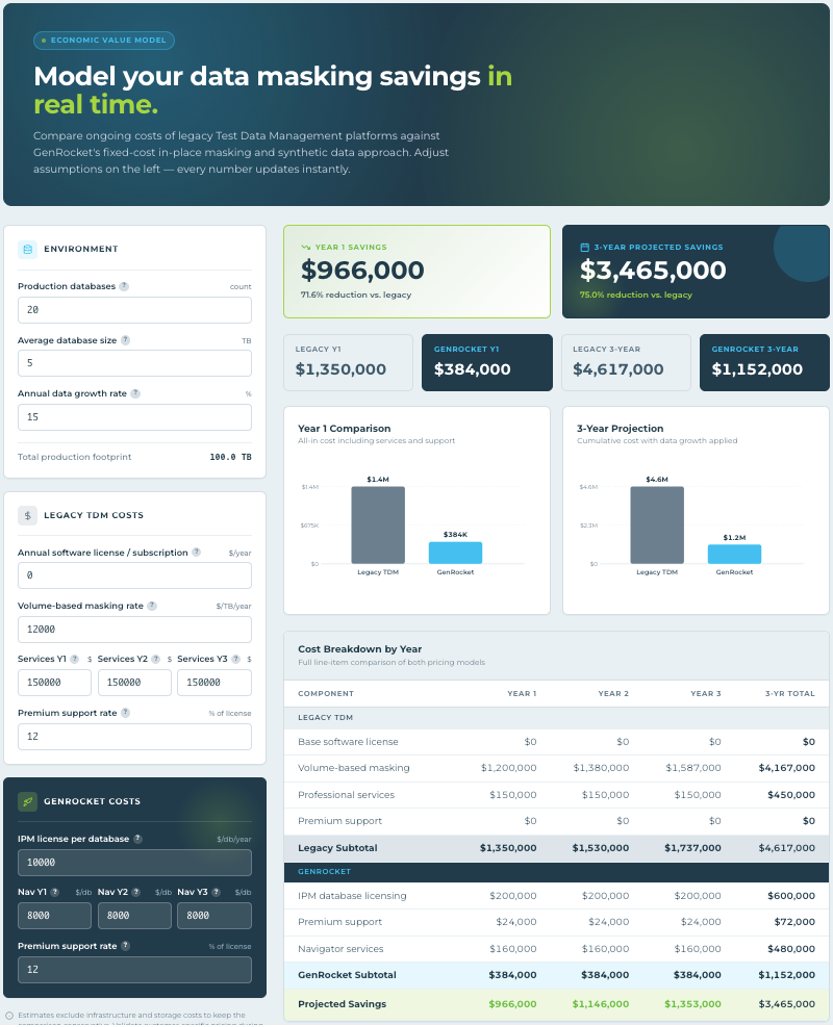
For many enterprises operating large multi-terabyte environments, the projected savings can be substantial.
Organizations evaluating TDM modernization can use the calculator to explore how transitioning away from expensive copy-and-mask architectures may reduce software licensing costs, infrastructure consumption, operational complexity, and long-term scaling challenges while positioning the enterprise for a synthetic-data-first future.
If your organization is currently evaluating modernization initiatives around test data management, GenRocket can develop an economic comparison illustrating the potential licensing, infrastructure, operational, and provisioning savings achievable through a transition to GenRocket’s Quality Evolution Platform.