Data Quality Evolution: A Bridge from Production Data to Synthetic Data
For decades, production data has been the foundation of software testing. Development and quality engineering teams have traditionally relied on copies of real operational datasets to validate application behavior. The process is familiar: extract production data, mask sensitive information, subset the dataset to reduce its size, move it into lower environments, and run testing cycles against it.
This model made sense for the software systems of the past. Applications were relatively centralized, release cycles were measured in months, and regulatory scrutiny around data privacy was far less intense than it is today. Production data offered a convenient way to approximate real-world conditions inside a testing environment, and most organizations built their test data management strategies around that assumption.
But the landscape of software engineering and data has changed dramatically.
The explosion of artificial intelligence, digital services, and distributed architectures has created unprecedented demand for high-quality data. Global digital transformation spending alone is expected to reach nearly $3.9 trillion by 2027, reflecting the scale at which organizations are investing in data-driven technologies (Next Move Strategy Consulting).
At the same time, privacy regulations and the scarcity of usable real-world datasets are forcing enterprises to rethink traditional approaches to test data.
These pressures are driving rapid growth in the synthetic data ecosystem. The global synthetic data generation market, valued at approximately $218 million in 2023, is projected to exceed $1.7 billion by 2030, growing at more than 35% annually as organizations search for scalable, privacy-safe alternatives to production data (Grand View Research).
Industry analysts increasingly believe that synthetic data will become a dominant source of training and testing data for AI systems in the coming decade as organizations confront privacy constraints and the limitations of real-world data.
Yet this transformation will not happen overnight.
Most enterprises remain deeply dependent on production data for testing, analytics, and operational validation. What we are witnessing today is not the immediate replacement of production data, but the beginning of a gradual transformation in how test data is created, managed, and delivered.
This transformation can best be understood as Data Quality Evolution.
Understanding Data Quality Evolution
The shift from production-derived data to synthetic data is often described as a technology transition. In reality, it is something deeper than that. What organizations are experiencing is an evolution in the quality and controllability of the data used for testing.
Production data reflects real operational history. It captures the transactions, behaviors, and patterns that have already occurred in the system. While this provides realism, it also introduces constraints. Test teams inherit whatever conditions happen to exist in production datasets, which means they are often limited in their ability to simulate rare events, failure scenarios, or future application states.
Synthetic data approaches this problem from the opposite direction. Instead of copying existing records, synthetic data allows teams to design the data they need for testing. Engineers can intentionally create edge cases, negative conditions, boundary values, and complex relational scenarios. They can generate massive volumes of data for performance testing or design statistically controlled datasets for training AI systems.
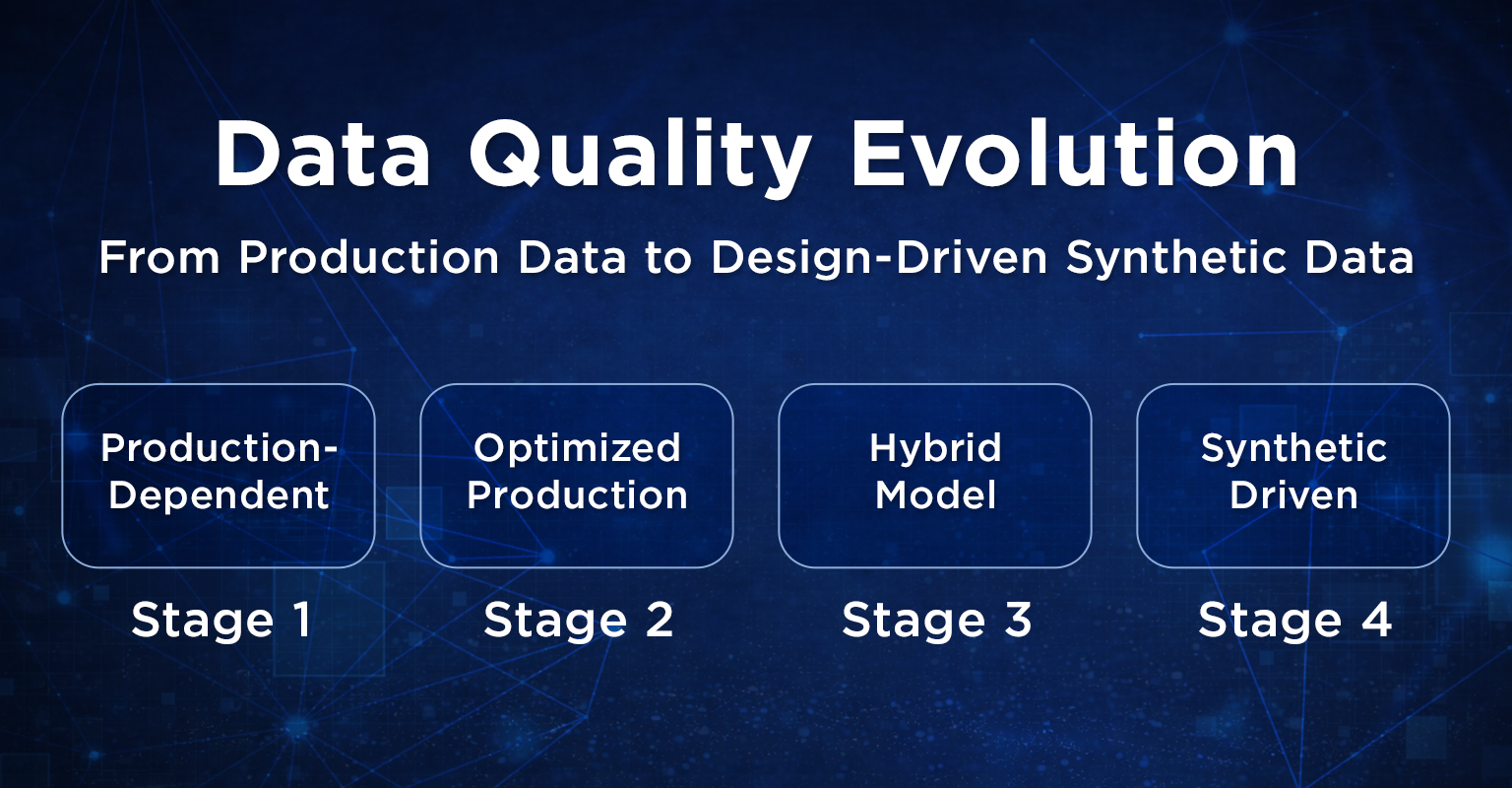
The result is a gradual progression in the quality and flexibility of test data—an evolutionary rather than revolutionary shift. Organizations typically move through several stages along this continuum.
In the earliest stage, testing is almost entirely dependent on production data. Masking tools are used to obscure sensitive information, and subsetting techniques reduce the size of datasets so they can be moved between environments. This approach provides realism but often introduces operational friction and governance complexity.
The next stage focuses on optimizing production data workflows. Enterprises invest in faster masking technologies, improved refresh processes, and stronger compliance controls in order to reduce the risk and operational overhead associated with handling production datasets.
Over time, many organizations begin experimenting with synthetic data generation. Rather than relying exclusively on production copies, teams generate specific test scenarios synthetically while continuing to use masked production data for baseline testing. This hybrid approach represents a transitional phase where synthetic data begins to augment traditional workflows.
Eventually, synthetic data becomes the dominant strategy. Test datasets are designed intentionally and generated on demand across development environments, eliminating many of the constraints associated with production data dependencies.
This progression—from production-dependent testing to design-driven synthetic data—represents the essence of Data Quality Evolution.
Why Production Data Alone Is No Longer Enough
The increasing pressure on production data workflows comes from several structural changes in how modern software is built and delivered.
One of the most significant pressures is the growing complexity of enterprise systems. Modern applications rarely rely on a single database or monolithic architecture. Instead, they consist of networks of services, APIs, message queues, and distributed data stores that must interact reliably across multiple environments. Maintaining coherent production-derived datasets across these systems can be extremely difficult, particularly when data refresh cycles lag behind rapid development changes.
Privacy and compliance requirements also introduce substantial challenges. Production datasets contain real customer information, and even when masking technologies are applied, organizations must maintain strict governance around how that data is copied, moved, and accessed. Regulatory frameworks such as GDPR, HIPAA, and CCPA have increased the risks associated with exposing sensitive data in non-production environments, making many enterprises more cautious about relying heavily on production datasets for testing.
Test coverage is a critical limitation imposed by legacy testing management systems. Production data reflects historical activity rather than the full range of scenarios that software must handle. Rare edge cases, failure conditions, and boundary values often do not appear in production datasets with sufficient frequency to support comprehensive testing. Test teams frequently find themselves manipulating records manually or creating small handcrafted datasets to simulate conditions that production data simply does not contain.
Modern development pipelines also demand speed. Continuous integration and continuous delivery workflows depend on rapid provisioning of test environments. When test data depends on production refresh cycles, masking jobs, and governance approvals, those processes can quickly become bottlenecks that slow down development pipelines.
None of these challenges imply that production data no longer has value. Production data remains extremely useful for analytics, operational insights, and certain types of testing scenarios where real behavioral patterns are important.
However, the limitations of relying exclusively on production data in quality engineering environments have become increasingly clear. And this is precisely where synthetic data begins to play a transformative role.
The Rise of Synthetic Data
Synthetic data generation allows engineering teams to move from reactive data usage toward intentional data design. Rather than hoping the right records exist inside a production dataset, teams can construct the exact scenarios they need. Instead of simply copying and masking historical data, software development and test teams can now engineer the precise data they need.
This capability dramatically expands what is possible in testing environments. Engineers can create complex relational datasets that preserve referential integrity across hundreds of tables, generate massive datasets for performance testing, or design statistically balanced datasets for machine learning training. They can simulate rare edge conditions or model future application states long before those scenarios ever occur in production systems.
Just as important, synthetic data eliminates the privacy risks associated with copying real customer information into test environments. Because the data is generated rather than copied, sensitive information is never exposed.
The advantages of synthetic data are significant. But despite these benefits, most enterprises are not yet ready to rely exclusively on synthetic data. They are still operating in a hybrid world.
The Missing Piece: A TDM Bridge Strategy
One of the most common challenges organizations face when adopting synthetic data is tool fragmentation. Traditional Test Data Management platforms are designed primarily for working with production data—masking it, subsetting it, and distributing it across environments. Synthetic data tools, meanwhile, often exist as entirely separate systems that generate data independently of those workflows.
This separation creates operational complexity. Teams must manage multiple tools, maintain separate governance processes, and reconcile different data provisioning models.
What organizations increasingly need instead is a unified platform that supports both sides of the equation: the continued use of production data where necessary and the gradual expansion of synthetic data generation where it provides clear advantages.
This is the philosophy behind GenRocket’s Quality Evolution Platform (QEP).
Rather than forcing enterprises to abandon production data workflows overnight, the platform enables organizations to modernize those workflows while simultaneously building toward a future dominated by synthetic data.
At the heart of this approach is what GenRocket calls the TDM Bridge Strategy.
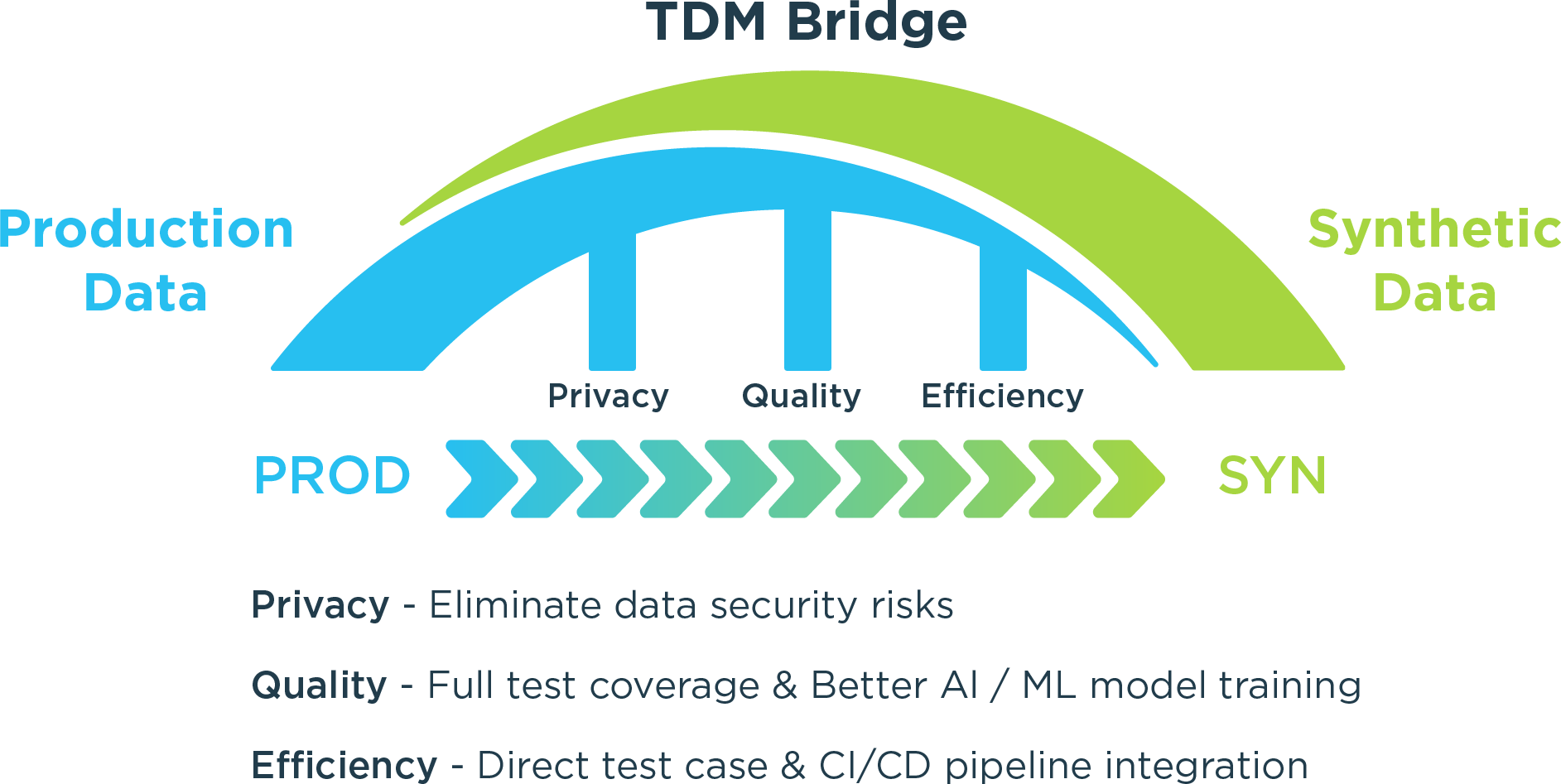
The bridge strategy recognizes that most enterprises cannot immediately replace production data with synthetic data. Instead, they must improve the way production data is handled today while enabling a gradual transition toward synthetic data generation.
GenRocket addresses the production-data side of this equation through its advanced In-Place Masking capabilities. These capabilities allow organizations to mask sensitive information directly within existing databases while preserving referential integrity and application behavior. By eliminating complex data movement workflows and dramatically accelerating masking processes, the platform enables enterprises to modernize their existing test data infrastructure.
This production-data foundation delivers three critical benefits—what we describe as the three S’s of modern test data operations.
- Security ensures that sensitive information remains protected while still allowing applications to behave realistically in test environments.
- Speed accelerates the masking and provisioning process so that development pipelines are no longer constrained by slow data refresh cycles.
- Savings come from eliminating the operational overhead and infrastructure costs associated with traditional test data management systems.
Together, these capabilities create a stable operational bridge to the future.
From that foundation, organizations can progressively expand their use of Design-Driven Synthetic Data, generating new datasets on demand while gradually reducing their dependence on production copies.
The Future of Test Data is Synthetic Data
As enterprises continue to modernize their quality engineering practices, the role of test data will change fundamentally.
Instead of copying static datasets from production systems, engineering teams will increasingly design the data they need for specific testing objectives. Synthetic data generation will allow organizations to simulate complex scenarios, scale testing environments instantly, and eliminate privacy risks associated with handling real customer information.
Production data will not disappear entirely. It will remain useful for certain types of validation and analytics. But the dominant paradigm for testing will shift toward intentional data design rather than reactive data copying.
This shift represents the next stage in Data Quality Evolution.
And the organizations that navigate this transition most successfully will be those that adopt platforms capable of supporting the entire journey—from production data optimization to fully synthetic data provisioning environments.
That vision is exactly what the GenRocket Quality Evolution Platform was designed to enable.
A bridge to the future of test data.
And a foundation for the next generation of enterprise software quality.