
Executive Overview
Enterprises depend on database masking performed by Test Data Management (TDM) systems to protect sensitive production information when provisioning test and training data for software development and testing. GenRocket, the technology leader in synthetic test data generation, now offers database masking through new In-Place Masking (IPM) technology with an even higher standard of security, performance and data quality.
The Natural Evolution of Test Data Management
Database masking solutions from traditional TDM vendors come with a high level of complexity and cost. However, the real challenge lies in what comes next. These legacy platforms perpetuate a paradigm of production data dependency and non-integrated workflows. They are not architected for the future of test data management where secure synthetic data is provisioned on-demand and delivered seamlessly into fully automated test environments.
GenRocket IPM: Familiar Capability, Future-Ready Architecture
GenRocket IPM is intentionally designed as a drop-in replacement for traditional TDM in-place masking. It mirrors the capabilities enterprises expect, including sensitive data discovery, in-database masking, and preservation of referential integrity across large datasets. And IPM is the foundation of an extensive data masking capability that includes intelligent data subsetting and flexible file masking.
Secure Masking Through Synthetic Data Replacement
GenRocket IPM uses Synthetic Data Replacement (SDR) to protect sensitive values. Rather than transforming or scrambling existing data, SDR replaces sensitive values entirely with synthetic data generated by GenRocket. This approach provides irreversible protection while preserving realistic data behavior, ensuring masked data remains usable for testing, validation, and downstream processing.
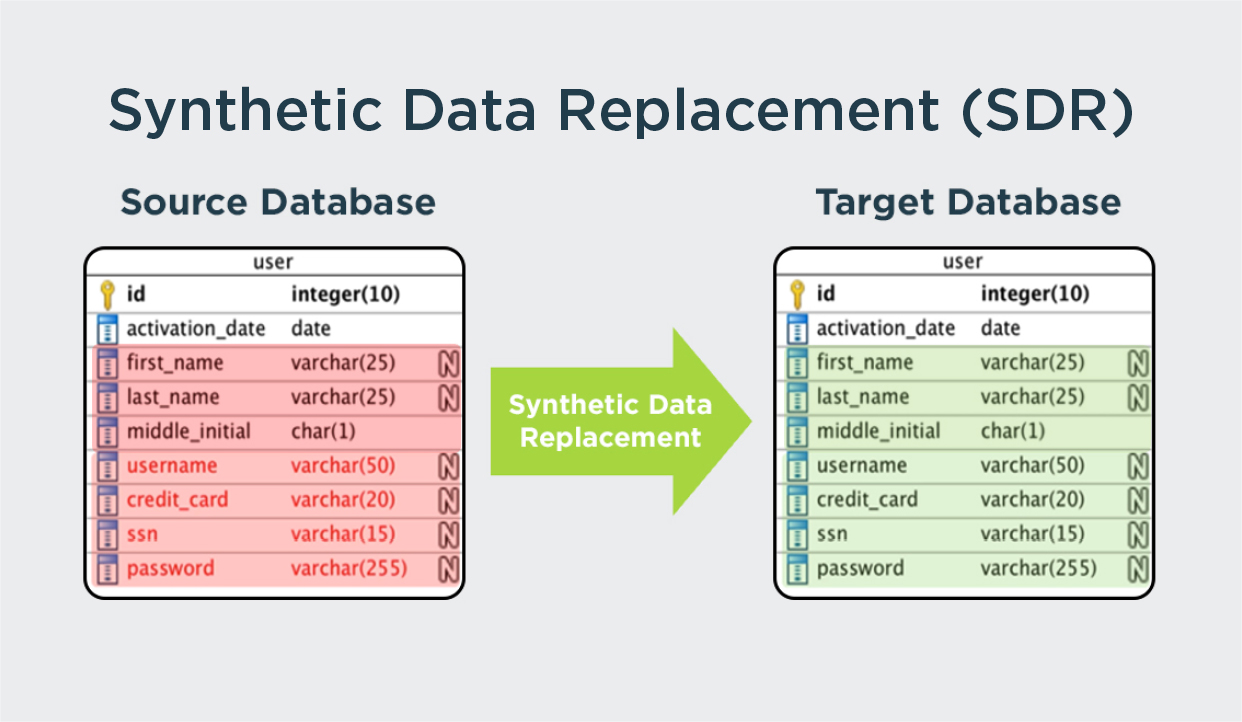
This is made possible by GenRocket’s metadata-driven approach for synthetic data replacement. With GenRocket, the entire in place masking process can be performed without production data ever leaving a secure production environment. That’s because GenRocket uses metadata to identify sensitive data values targeted for synthetic replacement.
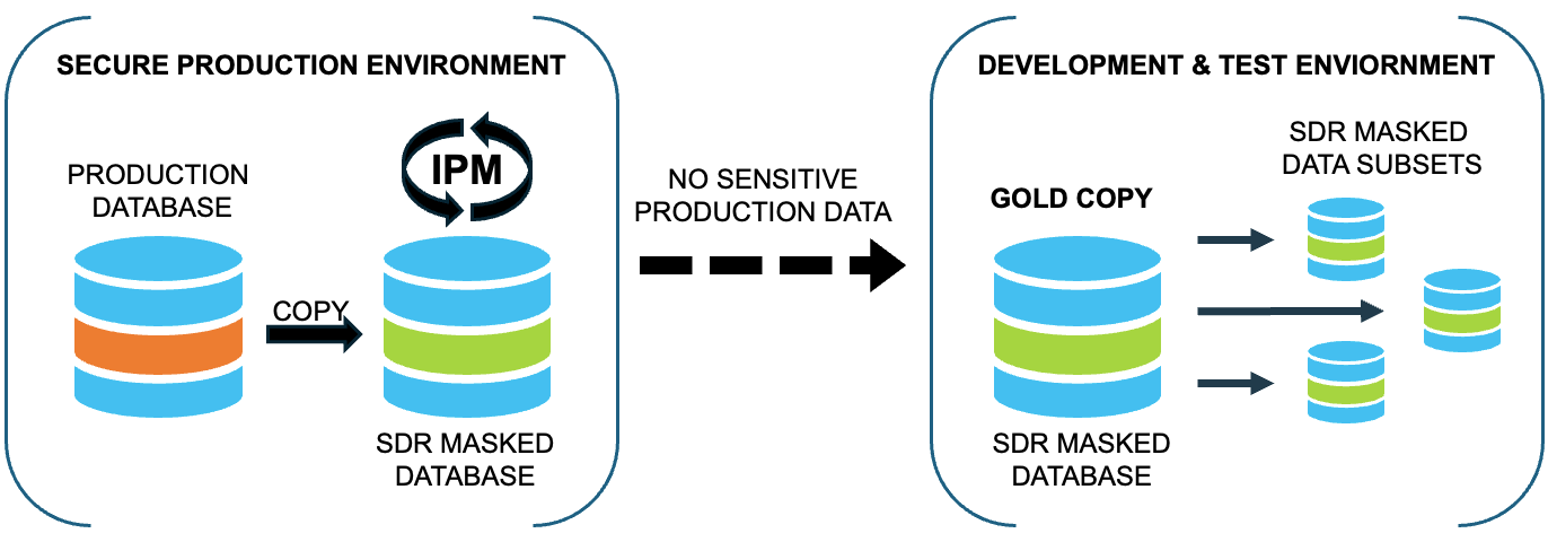
And for companies that do not yet have this mandate in place yet, it’s likely to be becoming soon. Increasingly organizations are looking to reduce if not eliminate the risk of security breaches and to ensure total compliance with global privacy laws.
Data Consistency and Referential Integrity by Design
GenRocket’s In-Place Masking (IPM) is architected to preserve data consistency and referential integrity across complex enterprise data landscapes—including multi-table schemas, cross-database dependencies, and heterogeneous platforms. IPM ensures that related values—such as primary and foreign keys, shared identifiers, and duplicated sensitive attributes—are deterministically replaced with the same synthetic values wherever they appear. The result is a secure, production-like dataset that remains fully usable for testing, analytics, integration, and compliance.
Enterprise-Class Performance at Scale
Performance is a non-negotiable requirement for in-place masking at enterprise scale. GenRocket IPM is engineered to meet and exceed the performance expectations established by leading TDM platforms. IPM achieves this through multi-threaded parallel processing, dynamically generated database-native stored procedures, and a distributed client-server architecture that supports horizontal scaling across tables and databases.
Validated Performance Benchmarks
The table below summarizes representative GenRocket IPM performance results across SQL Server and Oracle environments at 10 million and 100 million row volumes. Throughput is normalized as rows per minute to provide a consistent, executive-level view of performance.
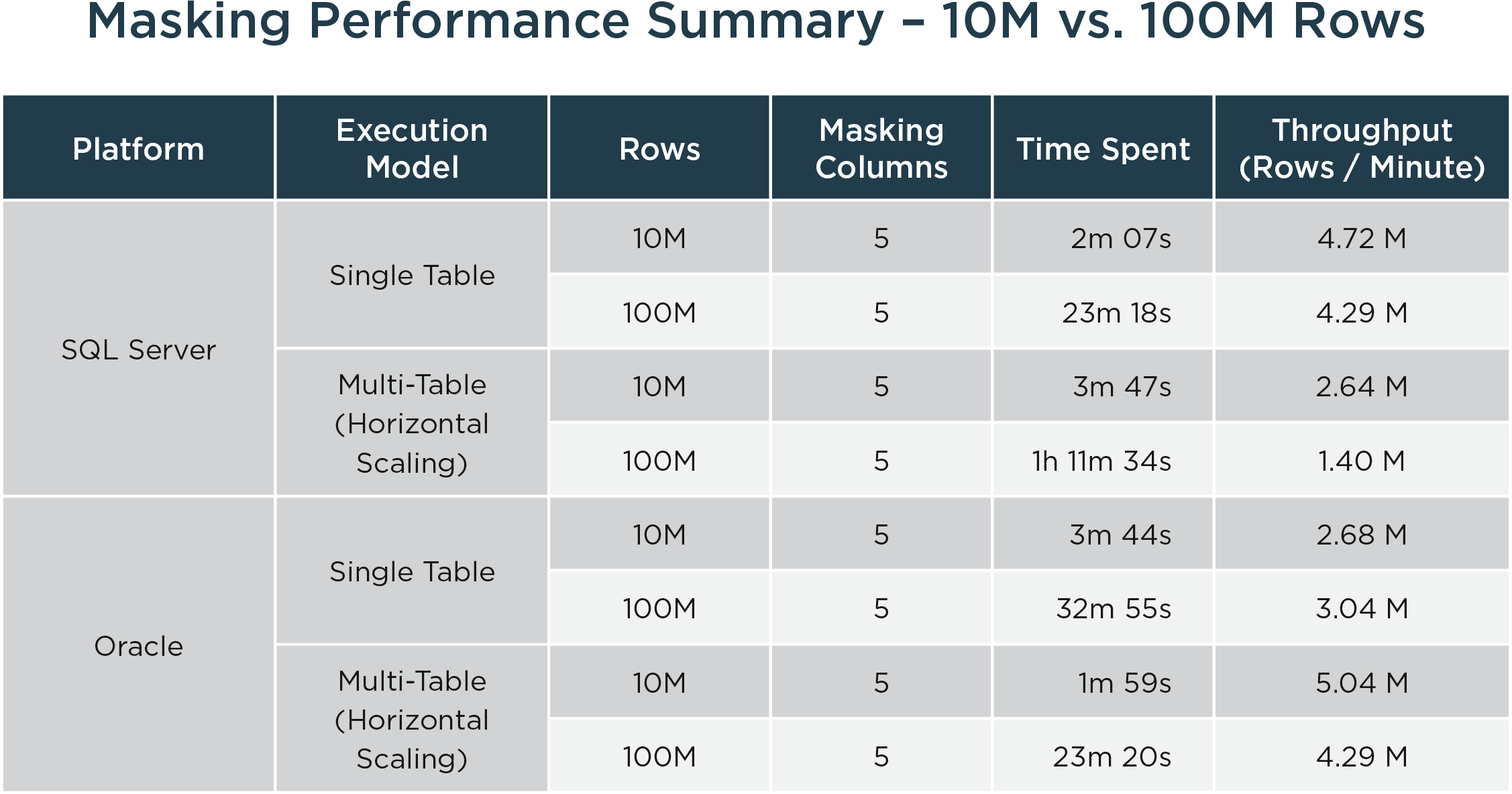
These results demonstrate consistent throughput as data volumes scale. Performance remains predictable across platforms and execution models, validating GenRocket IPM as an enterprise-ready in-place masking solution.
Supported Databases and System Requirements
GenRocket’s in-place masking supports Microsoft SQL Server and Oracle in its initial release, with PostgreSQL, MySQL, DB2 and Snowflake database solutions currently in development and test. The solution runs on Linux or MacOS, requires Java (Java 17+ for multi-table masking), and uses an SFTP server for metadata- driven mapping. Core platform components include GenRocket Runtime, G-Repository, G-Subset, and Data Column Profiling.
Compelling Economic Value
With GenRocket’s in place masking solution, Quality Engineering organizations can realize significant economic savings over traditional methods. First and foremost, GenRocket does not charge based on the amount of data that is being masked, as is the case with many other vendors. For a fixed annual license fee, any amount of data can be masked and provisioned any number of times. For enterprise-scale requirements, this often represents a six-figure or seven-figure annual savings.
From In-Place Masking to Design-Driven Data
While GenRocket IPM delivers the in-place masking capabilities enterprises require today, its strategic value extends further. IPM serves as the entry point to GenRocket’s broader Design-Driven Synthetic Data platform.
Organizations can adopt IPM as a direct replacement for existing masking tools and, over time, introduce synthetic, purpose-built data to support advanced testing, automation, and quality engineering—without disrupting established workflows.
By combining enterprise-class performance with a clear evolutionary path to design-driven synthetic data, GenRocket IPM enables organizations to protect sensitive data today and modernize their test data strategy for the future.
Security, Speed and Savings at Scale
With the addition of In Place Masking to GenRocket’s synthetic data platform, organizations can have the best of all worlds. With its metadata driven architecture and synthetic data replacement strategy, GenRocket offers unparalleled security and data privacy. It’s multi-threaded parallel processing approach delivers some of the highest performing masking operations available in any enterprise-class data masking platform. And with the opportunity to realize major cost savings over traditional solutions, GenRocket makes it extremely economical to solve today’s data provisioning challenges while positioning for the future of synthetic data.
Finally, GenRocket’s Navigator Services bring deep industry experience and technology know-how to guide the implementation and operation of its in-place masking and synthetic data capabilities. This makes GenRocket more than a leading technology company in test and training data. We are strategic partners with our customers in the delivery of the highest quality data that can be designed and deployed seamlessly in our customers automated release pipelines. The result is faster delivery, reduced risk, and complete confidence in the data that powers enterprise software and AI initiatives.