

Engineering Unstructured Healthcare Data for Testing, AI, and Compliance
In the healthcare industry, some of the most valuable information never lives neatly inside rows, columns, or relational tables. Instead, it exists as unstructured data—often referred to as free-text, clinical narratives, or simply raw data. This content captures the nuance of patient care and clinical decision-making, but it also presents one of healthcare IT’s most persistent challenges: how do you make unstructured data usable for testing, AI model training and compliance at enterprise scale—without compromising privacy, governance, or trust?
Unstructured healthcare data is defined as information that does not conform to a predefined model, schema, or format and cannot be easily managed with traditional relational databases or spreadsheet-based approaches. And while healthcare organizations have been dealing with unstructured data for decades, the urgency has intensified in recent years due to three overlapping forces:
- Digital transformation and modernization: More applications, more integrations, faster release cycles, and higher expectations for reliability.
- AI and automation adoption: NLP, intelligent document processing (IDP), summarization, decision support, and clinical workflow automation all demand data volume and variety.
- Privacy and regulatory pressure: While AI-based scanning and redaction tools have reduced friction around PHI exposure, privacy alone does not make unstructured data enterprise-ready.
The result is a familiar situation: healthcare organizations know their unstructured data contains massive value, but accessing it safely and using it repeatedly—especially for software engineering and AI initiatives—remains difficult.
How Healthcare Defines Unstructured Data
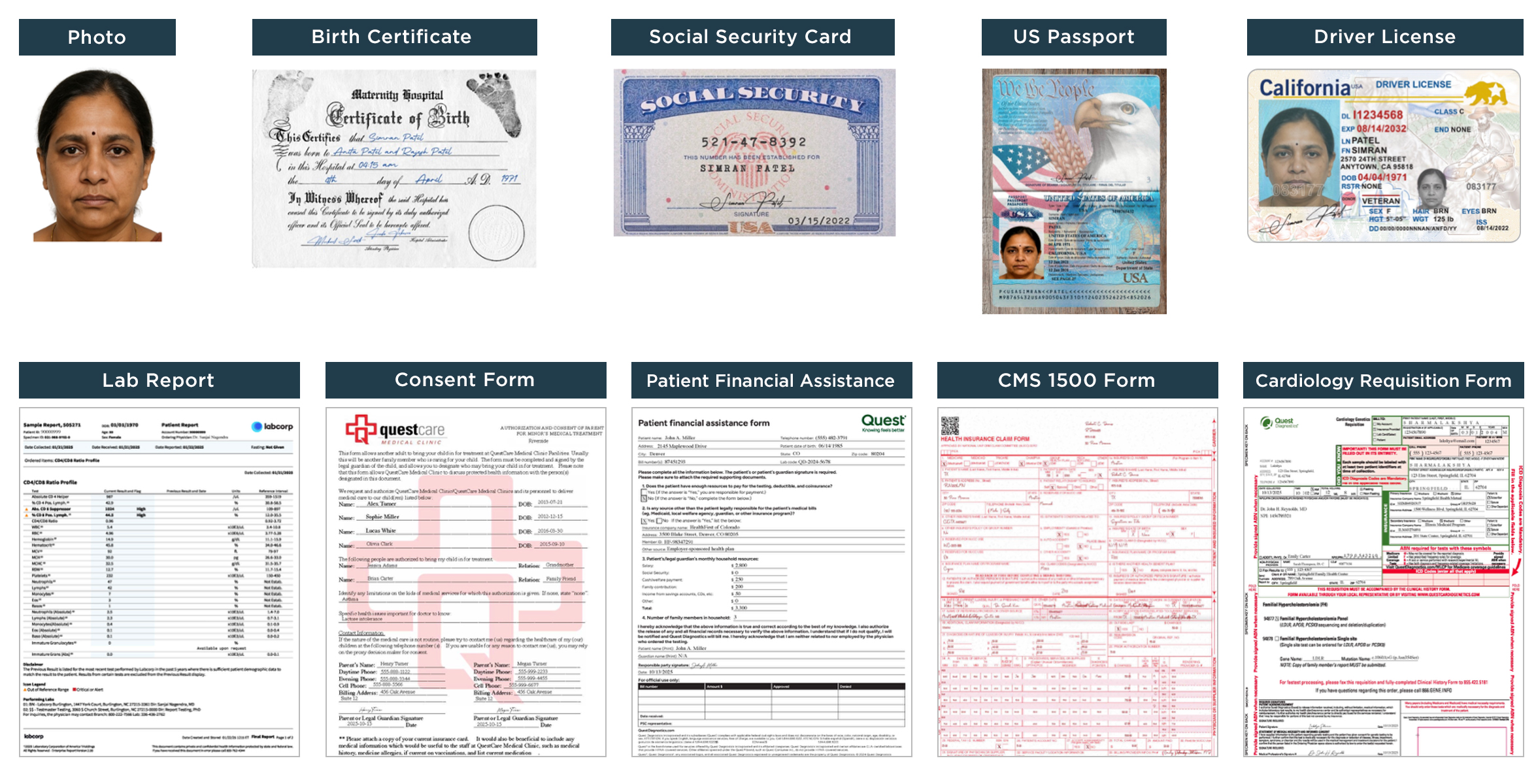
Healthcare professionals and informatics teams commonly classify unstructured data into several categories, each with distinct technical characteristics and downstream requirements.
Free-Text and Narrative Notes
These include clinician notes, progress notes, admission notes, discharge summaries, care plans, and consult notes. They often contain critical clinical context—symptoms, reasoning, assumptions, ambiguities, and next steps—but are written in natural language with highly variable structure.
Imaging and Diagnostic Reports
Radiology reports, pathology findings, ECG summaries, and DICOM assets such as MRI, CT, and X-ray images fall into this category. They typically combine structured metadata (e.g., modality, timestamps) with narrative interpretation and binary file formats. Even when there’s some structure, the most meaningful insight often lives in the radiologist’s written impression.
Audio and Voice Data
Voice dictations, doctor-patient conversations, recorded consults, ambient clinical documentation, and the resulting transcriptions are increasingly common. These sources are valuable but messy: they include interruptions, conversational phrasing, incomplete sentences, and clinical shorthand.
Scanned Documents and Unstructured Multimedia
Scanned PDFs, faxed forms, referral letters, handwritten notes, and patient-reported outcome measures are still widely used. Many of these arrive without reliable structure, often requiring OCR or additional processing to become usable.
Non-Computable Clinical Data
A key reality is that much unstructured healthcare data is effectively non-computable in its raw form. It requires NLP, OCR, speech-to-text, entity extraction, normalization, or other transformation steps before it can be queried, validated, or integrated into downstream systems.
Why Unstructured Data Becomes an Enterprise Bottleneck
If the challenge were simply “turn text into structure,” healthcare would already be done. The real obstacle is that enterprise use of unstructured data demands four things at the same time:
- Privacy: PHI must be protected, especially outside production.
- Fidelity: Data must reflect clinical reality closely enough to test workflows and train models.
- Repeatability: Teams need deterministic, reusable datasets—not one-off samples.
- Scale: The solution must work across environments, projects, releases, and teams.
In practice, organizations run into predictable failure modes:
- Software engineering teams can’t access realistic unstructured test data because production narratives and documents contain PHI and are restricted.
- Testing and QA suffer because limited data variety means limited coverage—especially for edge cases and rare conditions.
- AI/ML initiatives stall because training data is inconsistent, scarce, costly to curate, or difficult to govern.
- Operational overhead grows as teams rely on manual de-identification, ad hoc sampling, repeated approvals, and fragile pipelines.
The downstream cost is not just compliance risk—it’s slower delivery, lower quality, and reduced innovation capacity.
The Shift: From Processing Data to Engineering Data
Historically, healthcare organizations approached unstructured data as something to extract from, clean, and transform. That mindset leads to an endless pipeline problem: every new source adds work, every new use case adds risk, and every new project adds friction.
Leading organizations are increasingly adopting a different approach: treat unstructured healthcare data as something you can engineer deliberately—designed, generated, governed, and reproduced on demand—without relying on production PHI.
This is exactly the problem addressed by the Unstructured Data Accelerator (UDA) from GenRocket.
What UDA Does, in Practical Terms
UDA enables healthcare organizations to create high-fidelity synthetic unstructured data that mirrors the complexity and characteristics of real clinical content—while removing the privacy risk and operational burden of using production data.
At a high level, UDA is designed to help teams:
- Generate Realistic Unstructured Assets Without PHI
UDA supports the generation of synthetic clinical narratives, reports, documents, and other unstructured artifacts so teams can work with realistic content without exposing patient identities.
- Preserve Clinical Context and Relationships
Unstructured data rarely exists alone. Notes relate to encounters, orders, diagnoses, medications, labs, and imaging. UDA is intended to support contextual integrity, so unstructured content can align with structured records and with realistic clinical workflows.
- Support Repeatable Testing and Automation
Healthcare engineering teams don’t just need data—they need data that is repeatable, so automated testing and regression cycles produce consistent outcomes. UDA supports controlled generation so datasets can be recreated reliably across environments and releases.
- Scale Across Teams and Use Cases
UDA is built for enterprise usage patterns: multiple teams, frequent runs, different environments, and expanding use cases. Instead of treating unstructured data as a special one-off project, UDA supports broader adoption across engineering, QA, analytics, and AI teams.
- Enable “Data Readiness” for AI and NLP Workflows
Many AI initiatives fail not because models are weak, but because data is incomplete, inconsistent, or difficult to govern. UDA helps teams build datasets suitable for NLP and downstream processing—while maintaining the controls and transparency required in healthcare environments.
The Outcome: Faster Delivery, Higher Quality, Safer Innovation
When unstructured data becomes safe and repeatable, the impact shows up quickly:
- Engineering teams move faster because they aren’t blocked by PHI access issues.
- QA improves coverage because narrative and document test cases can be generated at scale.
- AI teams gain momentum because datasets can be created with the right mix of volume, variety, and governance.
- Compliance and security teams reduce risk because production PHI stops flowing into lower environments.
- Organizations gain confidence because datasets are controlled, explainable, and reproducible.
The common thread is simple: unstructured data stops being an uncontrolled liability and becomes a designed asset.
While AI-based scanning and redaction tools have made it easier to identify and remove sensitive values from unstructured healthcare data, they stop well short of making that data enterprise-ready.
These approaches reduce risk, but they do not create the scale, control, or consistency required to support modern software engineering, testing, and AI initiatives. In particular:
- They do not generate enterprise-scale volume
- They do not introduce controlled variety
- They do not create negative or edge-case data
- They are not centrally governed
- They are not repeatable or deterministic
- They are not pipeline-native
- They do not support test automation or regression
- They do not ensure consistent access to reliable unstructured data at scale
As a result, healthcare organizations are left with safer data—but not usable data at enterprise scale—reinforcing the need for a more deliberate, engineered approach to unstructured data.
Exploring UDA Solutions
If unstructured healthcare data is limiting your ability to modernize applications, increase test coverage, or responsibly scale AI initiatives, it may be time to move from “processing what you have” to “engineering what you need.”
If you’d like, we can walk you through how the Unstructured Data Accelerator (UDA) works and how healthcare organizations are using it to safely generate high-fidelity unstructured assets for testing and AI workflows.
Request a demonstration with one of our unstructured data specialists to see how UDA can support your use cases, your constraints, and your scale.


