Protected Provisioning: Making Production Documents Safe for Development, Testing, and Agentic AI
Development teams, testing organizations, and AI agents need documents that reflect the work a business actually does. A claims package, a loan application, an identity image, a patient record. These carry the layouts, narratives, annotations, and exceptions that decide whether an application reads information correctly and completes a workflow.
They also carry names, account numbers, health details, and confidential business information.
So the question isn’t whether teams should use realistic documents. It’s how those documents become available for reuse.
Two bad options, and a better one
When there’s no reliable preparation process, teams usually land in one of two places:
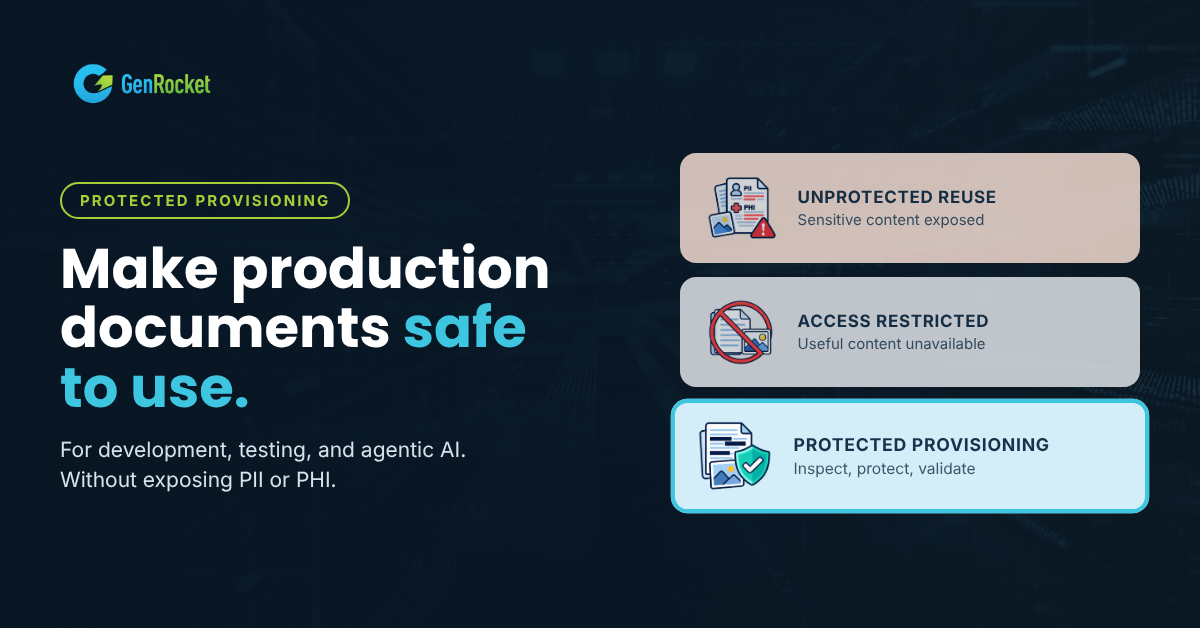
- Unprotected reuse: production documents are reused before sensitive content is properly removed. Exposure increases.
- Access restricted: documents are locked down. Engineering and AI work stalls, and important scenarios stay underrepresented.

The third option is Protected Provisioning: inspect, protect, validate, and provision documents for an approved purpose. Teams get material suited to their task. Owners keep control over what’s shared and how it’s used. Protection and accessibility become part of the same workflow.
In practice, that means:
- Scan documents and images for sensitive information such as names, account numbers, and health details
- Redact that content
- Check the prepared copies to confirm the information is gone and the document is still useful
- Govern who can use those copies and how long they’re kept
What the research shows
Most organizations can’t see what’s inside their documents
The Cloud Security Alliance’s 2026 study, commissioned by Thales, found that only 9% of respondents have real-time scanning for unstructured content. 23% have no scanning capability at all. Without that visibility, it’s hard to decide what needs protection before reuse.

Source: CSA 2026. 210 IT and security professionals surveyed, November 2025.
BARC’s 2026 unstructured-data research shows the same discovery problem from a different angle. You can’t select, protect, or authorize document collections you can’t locate.

Source: BARC 2026. 225 responses, February–March 2026.
AI file uploads carry sensitive data
Harmonic Security analyzed one million prompts and 20,000 uploaded files across 300+ AI applications. About one in five uploaded files contained sensitive information, and PDFs made up more than half of all uploads.

Files, not typed prompts, were the main source of several types of sensitive findings. For example, 75.3% of customer-profile findings came from uploaded files.

Source: Harmonic Security, Q2 2025. US and UK organizations, browser activity only.
Agentic AI turns enterprise content into an operating resource
Box’s 2026 State of AI in the Enterprise research shows why protection can’t come at the cost of availability. 96% say agent access to company content is important, yet only 36% of agent users have connected trusted content across many uses. Security and privacy concerns top the list of barriers.

Source: Box / Harris Poll. 1,640 IT decision-makers in the US, UK, France, and Japan, April–May 2026.
The takeaway: visibility is incomplete, sensitive content is already flowing into AI tools, and demand for enterprise content keeps rising. Teams need an approved way to prepare and provision useful documents.
Two complementary routes to secure document provisioning

Redact when authentic document characteristics matter
Production documents include complex layouts, annotations, handwriting, and image-quality variations that are hard to reproduce. Controlled redaction removes sensitive content while keeping the features the task needs.
Protection has to catch every occurrence. A patient’s name may sit in a header, a record number in a table, and identifying details in a clinical narrative.
Generate when controlled scenarios can replace production records
Synthetic documents use designed values, templates, and business scenarios, with no real consumer or patient records involved. For example:
- A lending team can create mortgage packages across income levels, employment histories, and loan products
- A healthcare team can create representative documentation for classification, extraction, and workflow testing
- Controlled variations cover missing information, negative tests, edge cases, and repeatable failure analysis
Six requirements for a repeatable provisioning process
A legitimate testing need should lead to an approved provisioning process with clear ownership, not an informal document export.
- Classify. Identify PII, PHI, confidential financial information, and other sensitive content, including content outside predictable form fields.
- Authorize. Name the accountable owner and define who can approve access for each purpose.
- Protect. Apply and validate redaction or de-identification before distribution.
- Offer synthetic alternatives. Use representative scenarios instead of production records wherever practical.
- Trace. Record sources, transformations, validation results, approvals, and provisioning activity.
- Manage the lifecycle. Enforce access, retention, and disposal across development, testing, vendor, and AI environments.
These build on frameworks teams already use, including NIST SP 800-53 and the NIST AI Risk Management Framework.
How GenRocket supports secure document provisioning
GenRocket’s Unstructured Data Accelerator (UDA) gives teams two paths, and a way to combine them.

- UDA-Redact detects PII and PHI in supported PDFs and images, with operator review and permanent redaction before provisioning. Batch processing, offline deployment, and audit capabilities keep the workflow controlled.
- UDA-Generate creates synthetic documents from templates and designed data, with unlimited variants, positive and negative scenarios, and rare edge cases that don’t exist in production.
Redact → Generate: the combined workflow
UDA-Redact identifies and removes sensitive values from production documents. Those fields become replacement targets in a protected template. UDA-Generate then fills them with controlled synthetic values, keeping the original layout and structure intact.

The result: documents with real-world structure and purpose-built data, ready for testing, AI training, and model validation.
Five questions to ask your team
- Where are documents reused? Can you locate sensitive document collections across dev, test, vendor, and AI environments?
- Who authorizes access? Are business owners, privacy, and security involved?
- How is protection validated? Can you confirm removed information can’t be recovered?
- Could synthetic documents meet the need? Have teams checked whether designed scenarios cover their requirements?
- Can compliance be demonstrated? Is provisioning traceable and governed by access, retention, and disposal policies?
Sensitive information stays sensitive whether it’s in a PDF, a scanned form, or a test environment. Data protection has to follow the data.
| Get the full white paper
See the complete research, the six-part provisioning framework, and how redaction and synthetic generation work together. |