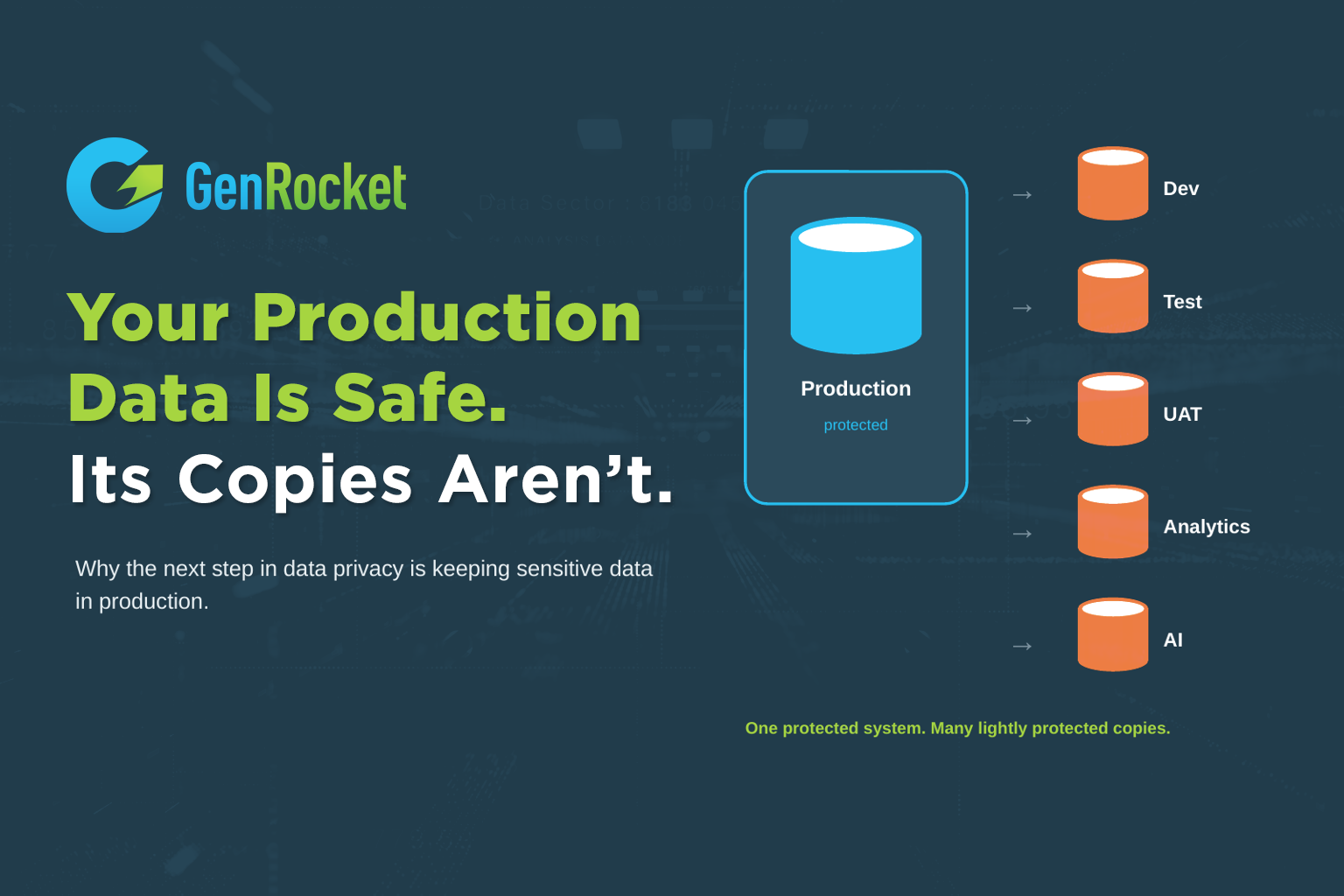
Your Production Data Is Safe. Its Copies Aren’t.
Why the next step in data privacy is keeping sensitive data in production.
Sensitive Data Should Never Leave Production
Ask a security team where its most sensitive data lives and the answer comes fast: production. It has the strongest controls, the tightest access and the closest monitoring.
Ask how many copies of that data sit outside production, and the answer takes longer.
Developers, testers, analysts, data scientists and now AI platforms all need realistic data. For years the quickest way to give it to them has been a copy of production. So one well-protected dataset turns into many lightly protected ones.
How far production data really travels
This isn’t an edge case. It’s how most organizations work today.
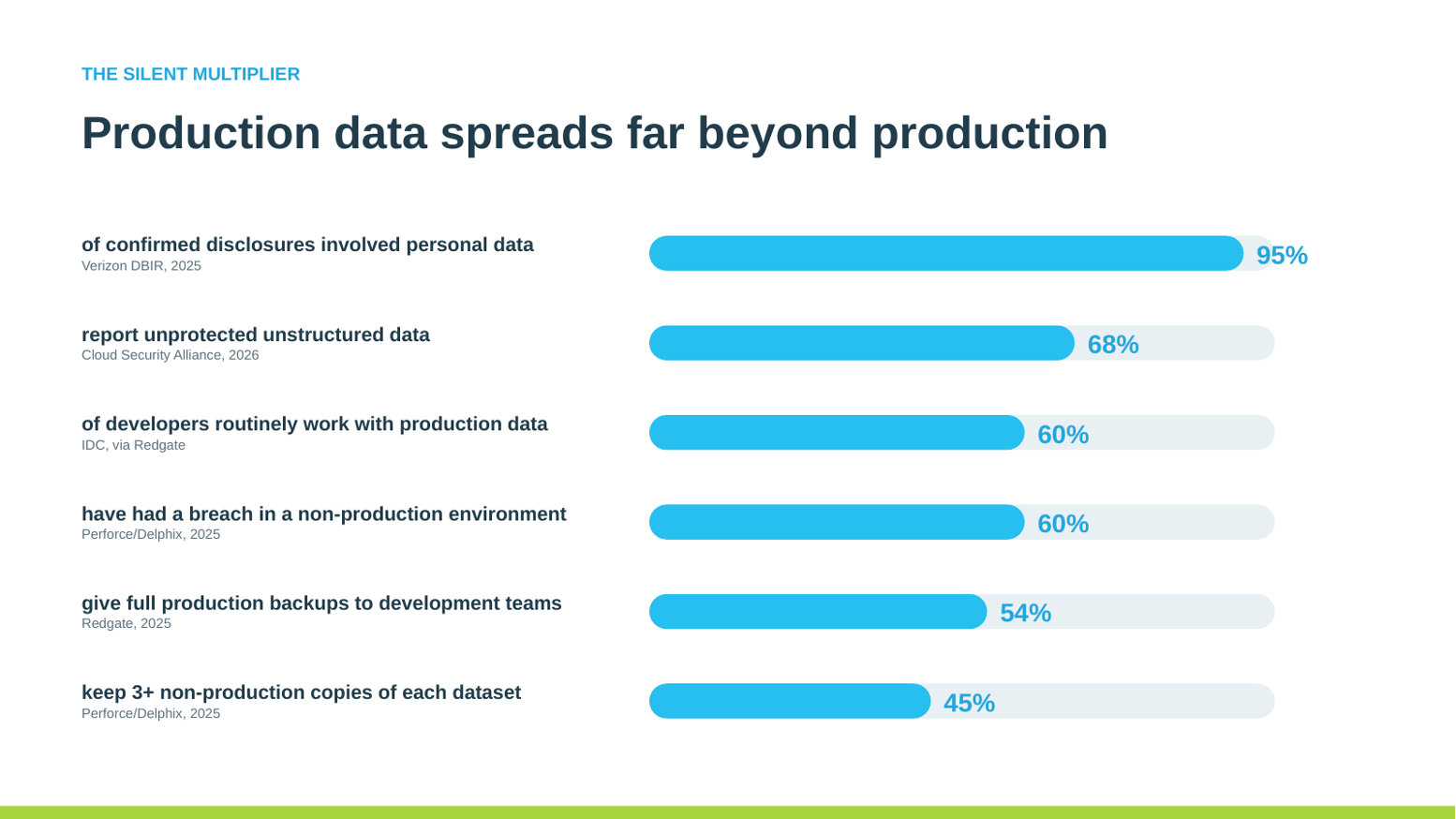
Another 39% of organizations hand developers subsets of production. Only 7% rely mainly on non-production data sources (Redgate, 2025).
Each copy carries the full sensitivity of the original, usually with broader access and less oversight. For the security program, that means more systems in audit scope, more people touching regulated data and more places where one misconfiguration becomes a reportable breach.
Masking copies has a timing problem
Most organizations already mask some non-production data. Only 16% use synthetic data as their main approach for sensitive dev and test data.
The usual pattern is to copy production first and mask the copy second. By the time the data is protected, it has already left production, and every refresh repeats the exposure.
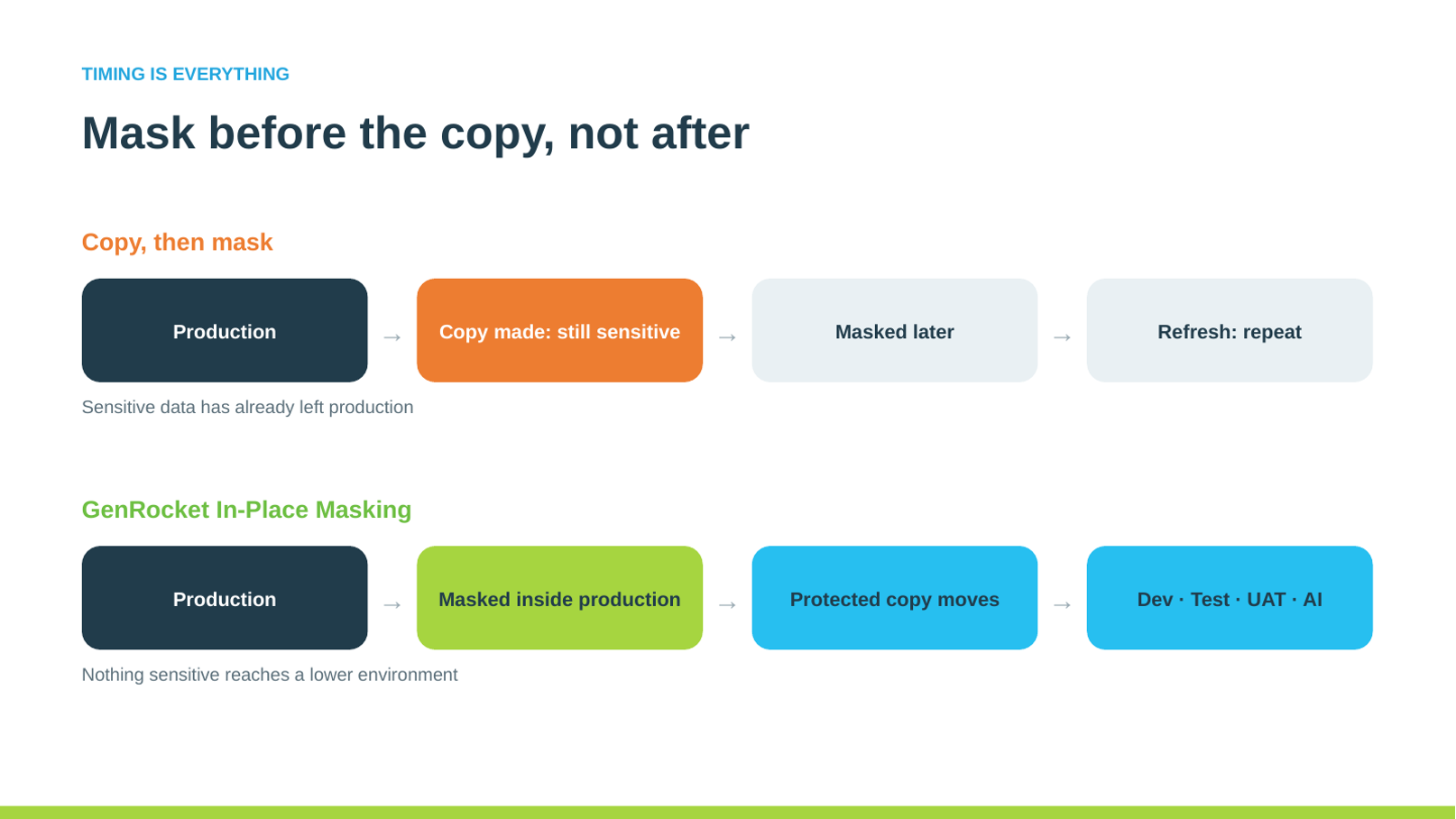
There are other gaps too. Algorithmic obfuscation can break the relationships applications depend on. Documents and images are often skipped. And masked production can only test what production already contains: no edge cases, negative paths or future states.
A path, not a rip-and-replace
GenRocket’s Secure Enterprise Data Platform gets you off production data in three phases. Each one pays off on its own.
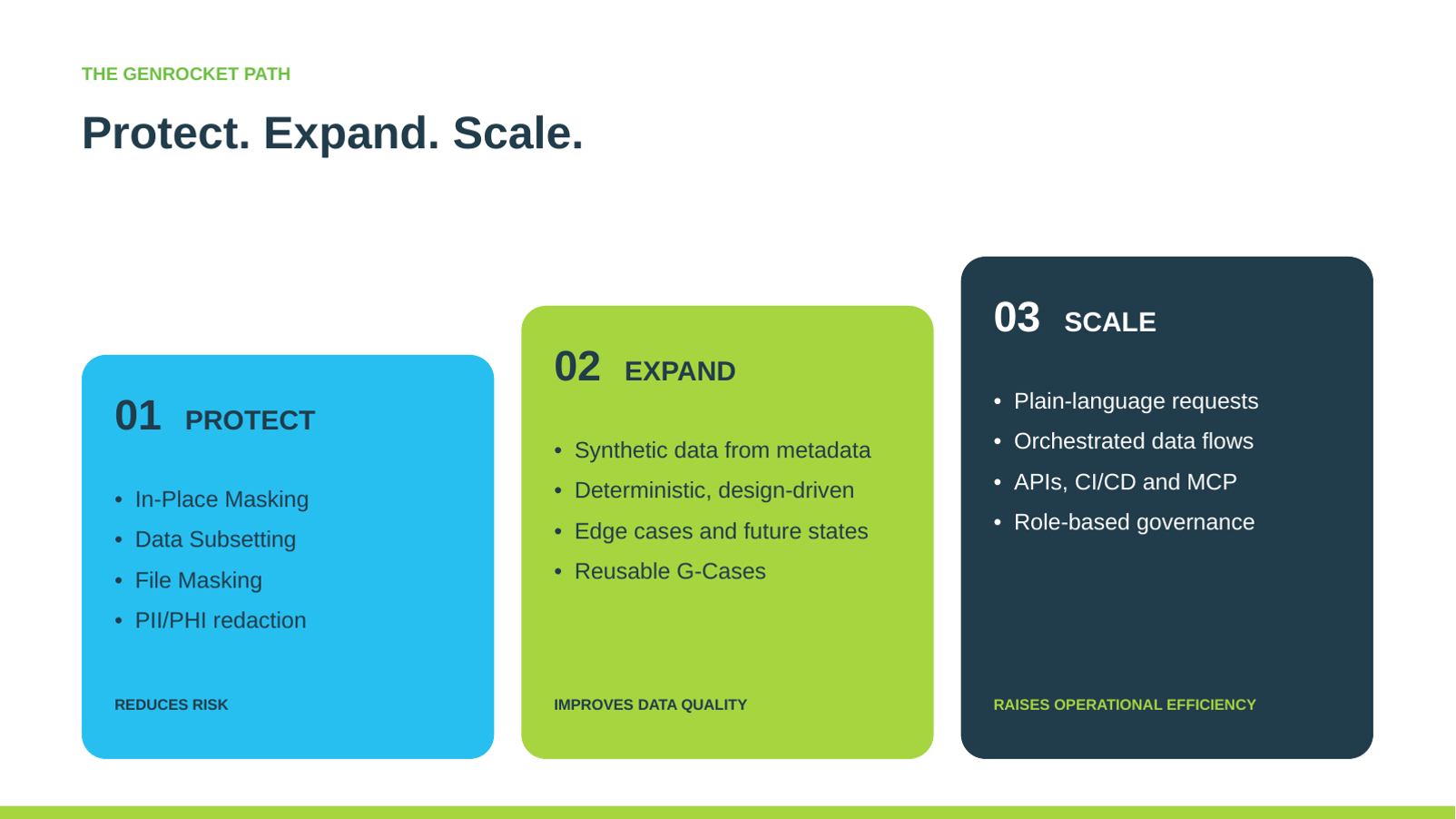
- Protect: secure data where it lives. In-Place Masking masks a complete database inside the production zone. Metadata finds the sensitive fields, and each value is replaced with a deterministic synthetic value, so the relationships applications rely on stay intact. Data Subsetting, File Masking and PII/PHI redaction (UDA-Redact) cover smaller datasets, files, documents and images.
- Expand: stop depending on production. Synthetic data is generated from metadata, not records. Teams design exactly the conditions they need, including the rare and the not-yet-seen. Each design is saved as a reusable G-Case, so the same governed data can be provisioned again on demand. The platform runs 750+ data generators across 125 data formats and produces millions to billions of rows in minutes.
- Scale: make the safe option the fast one. People describe what they need, and AI turns the request into a specification. Data flows to teams, pipelines and AI agents through APIs, CI/CD and the Model Context Protocol (MCP), with role-based access and audit trails throughout.
Where AI fits, and where it doesn’t
About 70% of organizations see significant risk in using proprietary or customer information for AI training (Cisco 2026 Data Privacy Benchmark Study). Letting a generative model create test data adds more problems: output is probabilistic, values can be hallucinated, results can’t be reproduced and costs climb with volume.
GenRocket uses AI to understand the request, not to make the data.
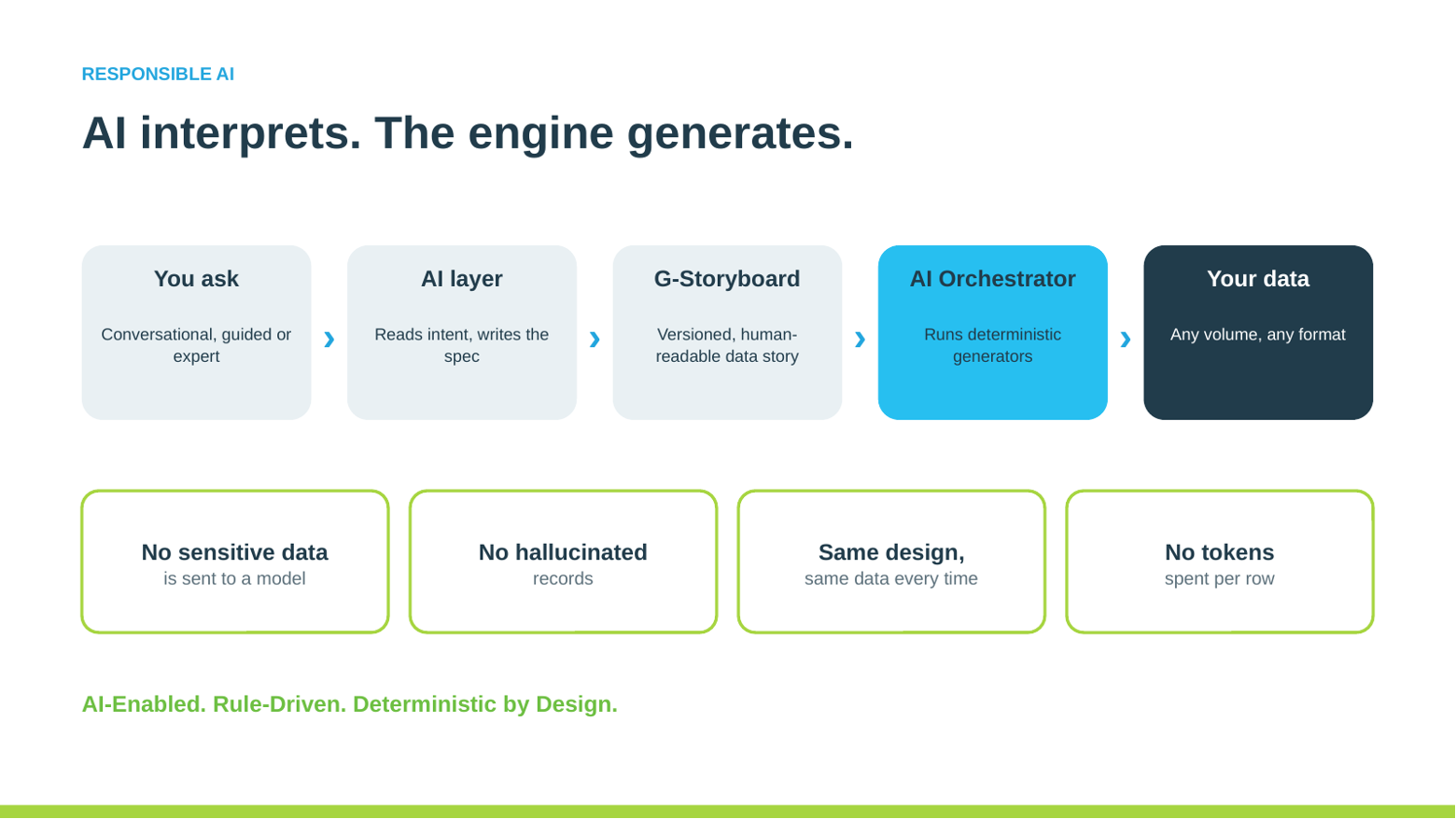
Every request becomes a G-Storyboard data story: structured, human-readable and version-controlled. The AI Orchestrator then runs deterministic generators to produce the data. No sensitive data goes to a model, no tokens are spent per row, and expert users can skip AI entirely.
What changes for the security program
- Sensitive data stays in production instead of spreading across environments.
- Dev, test and AI environments drop out of audit scope once they hold no real customer data.
- Fewer people need access to regulated data, so there are fewer access requests to approve.
- AI models and agents work from governed synthetic data, not customer records.
- Every dataset traces back to a versioned design, with role-based access and audit trails.
When governed data is the fastest way to get data, teams stop asking for production copies.
Where to start
- Assess. Map every non-production copy of production data and which environments are in audit scope.
- Protect. Mask your highest-risk database in place.
- Expand. Pick one use case and build it as reusable synthetic data.
- Scale. Add AI-assisted provisioning across teams.
| Get the full white paper
GenRocket’s Secure Enterprise Data Platform: Sensitive Data Never Leaves Production covers the architecture, governance controls and a four-step plan to get started. |